B.Sc. Engg. (Gold Medalist), University of Engineering and Technology (UET) Lahore, Pakistan – Joint European Master in Materials Science (EMMS), Technishe Universität Hamburg Harburg (TUHH), Deutschland, Universidade de Aveiro (UA), Portugal and Aalborg Universitet (AAU), Denamarka – Master (Nanoscience), Euskal Herriko Unibersitatea / Universidad del Pais Vasco (EHU/UPV), Espania – PhD (Aerospace Engineering), RMIT University, Melbourne, Australia
Design of exhaust nozzle (including type – bell shape)
Design of ignition system and re-design to eliminate to achieve self ignition
Design of heat generation system
Design of cooling system (regenerative cooling)
Calculation of heat load required to produce a certain amount of thrust
Calculation of exhaust velocity.
Tubing distribution, sizing, assembly and manufacturing
Design of sound water suppression system
Amount of water (water load calculation) required from thrust or amount of heat generated as a result of combustion.
Rate of heat (energy) transfer and value of exhaust velocity.
Intensity of sound produced from burning of certain amount of fuel / second (Rate of combustion)
Rate of flow of water required to suppress that sound wave(s)
Pumping (Number, type and arrangement of pumps and motors required)
Tubing (size and amount of tubes required)
Valves (Type, size and number of valves required)
Line diagrams
Flow diagrams
Skid or mounting structure (including type, size and number of structural elements (Channels (Cs), Is, Tees, Ls) and fastening mechanisms (nut, bolt, rivets or weld) calculations.
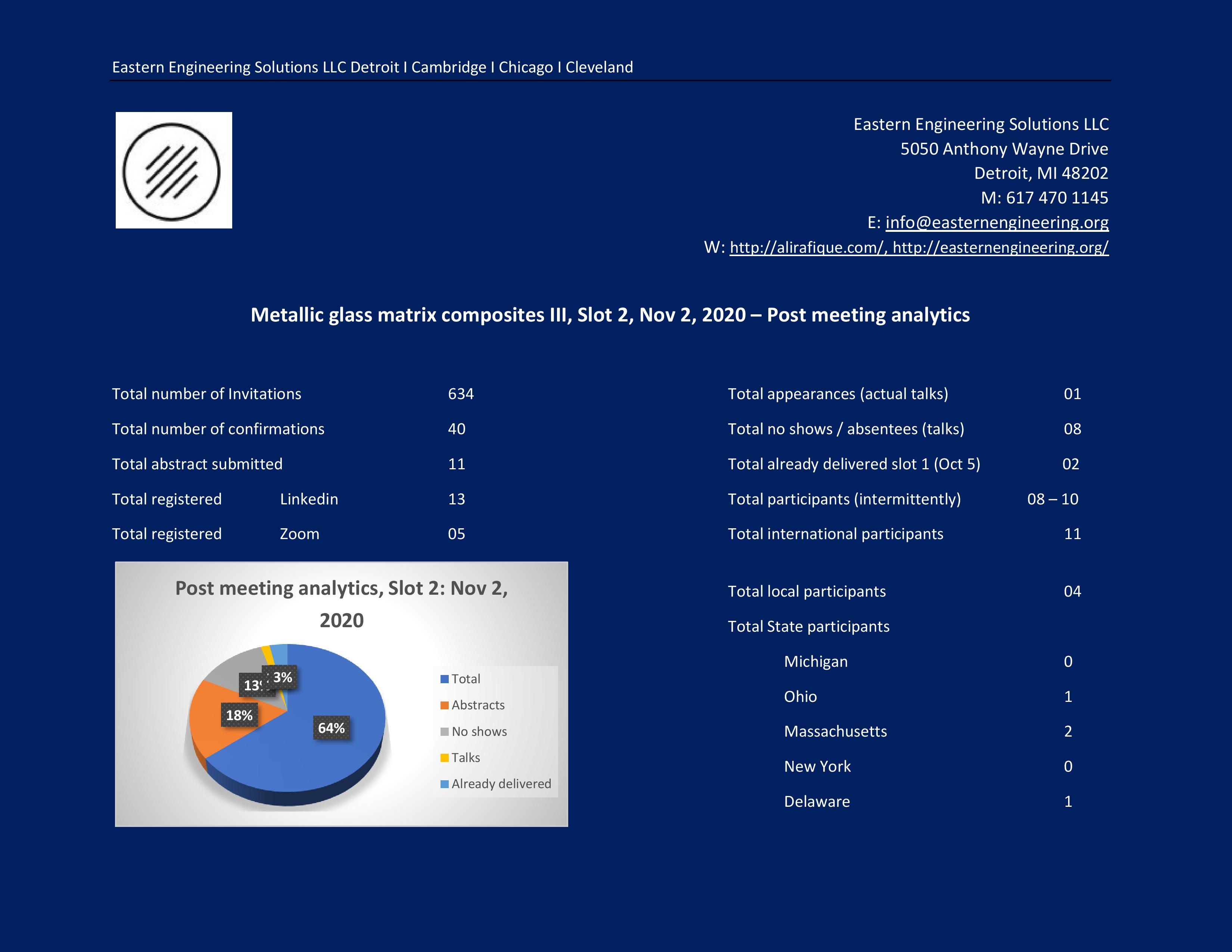
This year, this is a ‘Virtual / online only’ event for confirmed attendees. Off site / online presentations will be performed via Zoom. Dates and timings are available in book of abstracts. This years, for the convenience of attendees, this event is happening on two dates i-e Oct 5 – 6, 2020 and November 2 – 3, 2020. Those who may not be able to attend on first dates may join on second occasion as per their convenience. We understand, current situation and have made best possible efforts, and provided best possible solutions for our valued guests, attendees and speakers.
Registration
This is free to attend event. There is no registration fee at all. If you have already paid, it will be refunded. No third party or individual is authorized or permitted to advertise or collect any fee for this event at all. An online pre-registration is mandatory as per platform policy and requirements as sent in invitation email. On-site / On spot registration will be available as per platform policy but is discouraged. Students must be under the age of 35 and must have valid student ID.
Present Global Pandemic: Coronavirus, symptoms, asymptomatic coronavirus, COVID, asymptomatic covid, COVID-19, associated symptoms, syndromes and complications
Eastern Engineering Solutions LLC has been monitoring the spread of Coronavirus, symptoms, asymptomatic coronavirus, COVID, asymptomatic covid, COVID-19, associated symptoms, syndromes and complications, We particularly consult with the Centers for Disease Control and Prevention (CDC) website, the World Health Organization (WHO) website and our local partners and government. As of today, the event will remain on schedule and will be held online only.
— ADVISORY —
Unfortunately, a note is published on former MS&T website
ADVISORY: A solicitation is circulating for presenters to participate in a symposium titled “Bulk Metallic Glass Matrix Composites III.” This symposium is not approved for presentation at MS&T20 and no abstracts are being collected for it by event organizers. Any direction or requests to the contrary are incorrect.
Please disregard. This symposium is happening as scheduled. Eastern Engineering Solutions LLC does not endorse this note and highly condemn such unprofessional, unethical, derogatory actions, bias behaviors, corruption (personal and institutional), feminism, veterans, treachery, predatory behaviors, thuggery, and theft and damage of knowledge. We sincerely and deeply apologize for any inconvenience caused.
An award of waiver of Article Processing Charges (999$) is available to best speaker. This will be judged on the basis of quality of abstract, speech and relevance to meeting’s scope.
Proceedings will be published in a special issue of journal “Engineering”. More details may be found here. All speakers are highly encouraged to submit their full length articles.
Design and development of fire fighting (Alarm, Hydrant, sprinkler, and pumping unit(s)) Systems for fire detection and protection in multistory buildings and industry.
Hydrants and Sprinklers
Design, calculations, layout, CAD drawing preparation and tendering of Fire hydrant and Fire sprinklers system(s) in buildings, localities/towns and industry as per NFPA and/or custom Standards
Services include
Optimum water resource determination
Selection of suitable fire protection (single and/or combination) systems according to nature of hazard, area occupancy, building type etc.) as per NFPA and/or custom standards
Complete selection, determination (dry and/or wet) and layout of piping (single and/or branched) network as per NFPA and/or custom standards
Piping calculations (selection of pipe type and size) as per NFPA, API and/or custom standards
Determination of hydrant requirement (nature and type of cabinet and hose real selection and calculations)
Plumbing work (calculations, selection and determination of elbows, connectors, reducers, expanders, joints etc.)
Determination of water requirement
Pumping requirements calculations and selection of pump/pump set(s) (pressure maintenance/boosting units)
Design (nature and type) and positioning of water storage tank
Complete design and manufacturing of pressure maintenance/boosting units including their size and positioning
Fire fighting pumping unit (FFPU)
Design, Development, Engineering (calculations, analysis (mechanical, electrical, thermal, flow, stress, noise etc.), CAD drawing preparation, Tendering, Procurement, Manufacturing/Fabrication, Installation, Testing and Commissioning after sale services of fire fighting pumping unit consisting of
Primary Pump (Electrical)
Backup Pump (Diesel engine driven)
Pressure compensating/Jockey Pump (Electrical)
Services include
Pump selection (as per NFPA Standards)
Motor Selection
Engine Selection
Cascade development (single or multiple/combination pump stands, single and/or common suction and discharge etc.)
Flow calculations
Hydraulic calculations of main system
Calculation of losses in piping and pump set and their incorporation back into the final design as per NFPA and/or custom standards)
Valve selection (calculations and analysis for types, ratings, characteristics (linear, equal percentage etc.))
Piping (calculations and analysis for size, lengths etc)
Diagram development (Flow/Hydraulic, piping, electrical etc.)
Instrumentation (Ammeter, Voltmeter, tachometer, flow meter, temperature and pressure gauges etc.) selection and integration
Flange, fasteners (nut, bolt, stud) and connectors type, calculations and selection (strength calculations, pressure calculations, life determination/estimation calculations, welding requirements determination)
Water and diesel tank design and making
Control System development (Calculations for Sensor(s), connectors, controller etc. including control unit preparation (diagram, positioning and making of control unit)
Complete controller (selection, parameter determinations, programming etc.) and integration
Skid design and analysis (stress, structural and mechanical etc.)
Civil foundation design and development (calculations (structural, stress etc.)
Facilitation of ready equipment/material supply via close personal liaison with renowned manufacturers (KSB and Grundfos for pumps, KSB, Siemens for motors, MAN, CAT, Perkins for Engines, KSB, Danfos for valves, KSB, Siemens for controls etc.) upon order
Mundus Foundation
Edifício da Reitoria, Universidade de Aveiro, Aveiro 3810-193, Portugal
Pakistan Address:
c/o M. M. Ali Rafique, IRCBM, COMSATS Institute of information technology, Lahore, 54000, Pakistan
Shape memory alloys (SMAs) are alloys that “remember” their original shapes. They exhibit two very unique properties pseudo-electricity, and shape memory effect. SMAs are useful for such applications as actuators which are materials that “change shape, stiffness, position, natural frequency, and other mechanical characteristics in response to temperature or electromagnetic fields” [1]. The potential uses for SMAs especially as actuators have broadened the spectrum of many scientific fields. The study of the history and development of SMAs can provide an insight into a material involved in cutting-edge technology. The diverse applications for these metals have made them increasingly important and visible to the world.
Arne Olander first observed these unusual properties in 1938 (Oksuta and Wayman, 1998) but not until the 1960’s were any serious research advances made in the field of shape memory alloys. Nickel-titanium alloys have been found to be the most useful of all SMAs. Other shape memory alloys include copper-aluminum-nickel, copper-zinc-aluminum, and iron- manganesesilicon alloys. [2] The generic name for the family of nickel-titanium alloys is Nitinol. In 1961, Nitinol, which stands for Nickel Titanium Naval Ordnance Laboratory, was discovered to possess the unique property of having shape memory. William J. Buehler, a researcher at the Naval Ordnance Laboratory in White Oak, Maryland, was the one to discover this shape memory alloy. The actual discovery of the shape memory property of Nitinol came about by accident. At a laboratory management meeting, a strip of Nitinol was presented that was bent out of shape many times. One of the people present, Dr. David S. Muzzey, heated it with his pipe lighter, and surprisingly, the strip stretched back to its original form. [3]
References:
[1] Rogers, Craig. “Intelligent Materials.” Scientific American Sept. 1995: 154-157.







 Muhammad Musaddique Ali Rafique
You must be logged in to post a comment.