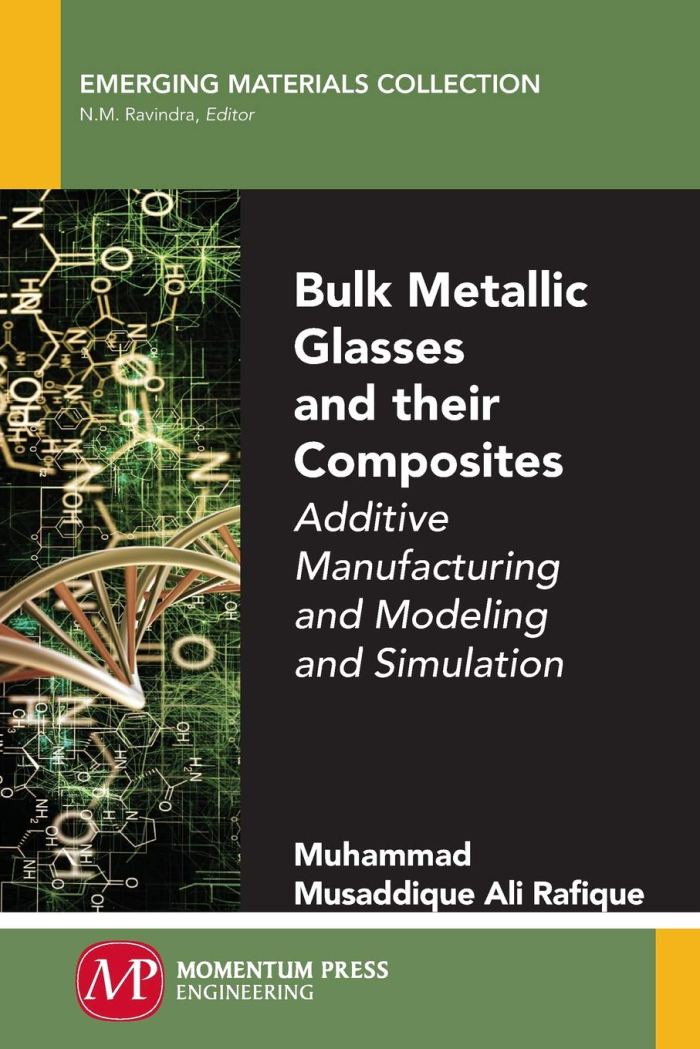
Bulk Metallic Glass Matrix Composites
Muhammad Musaddique Ali Rafique
B.Sc. Engg. (Gold Medalist), University of Engineering and Technology (UET) Lahore, Pakistan – Joint European Master in Materials Science (EMMS), Technishe Universität Hamburg Harburg (TUHH), Deutschland, Universidade de Aveiro (UA), Portugal and Aalborg Universitet (AAU), Denamarka – Master (Nanoscience), Euskal Herriko Unibersitatea / Universidad del Pais Vasco (EHU/UPV), Espania – PhD (Aerospace Engineering), RMIT University, Melbourne, Australia
Shape memory alloys (SMAs) are alloys that “remember” their original shapes. They exhibit two very unique properties pseudo-electricity, and shape memory effect. SMAs are useful for such applications as actuators which are materials that “change shape, stiffness, position, natural frequency, and other mechanical characteristics in response to temperature or electromagnetic fields” [1]. The potential uses for SMAs especially as actuators have broadened the spectrum of many scientific fields. The study of the history and development of SMAs can provide an insight into a material involved in cutting-edge technology. The diverse applications for these metals have made them increasingly important and visible to the world.
Arne Olander first observed these unusual properties in 1938 (Oksuta and Wayman, 1998) but not until the 1960’s were any serious research advances made in the field of shape memory alloys. Nickel-titanium alloys have been found to be the most useful of all SMAs. Other shape memory alloys include copper-aluminum-nickel, copper-zinc-aluminum, and iron- manganesesilicon alloys. [2] The generic name for the family of nickel-titanium alloys is Nitinol. In 1961, Nitinol, which stands for Nickel Titanium Naval Ordnance Laboratory, was discovered to possess the unique property of having shape memory. William J. Buehler, a researcher at the Naval Ordnance Laboratory in White Oak, Maryland, was the one to discover this shape memory alloy. The actual discovery of the shape memory property of Nitinol came about by accident. At a laboratory management meeting, a strip of Nitinol was presented that was bent out of shape many times. One of the people present, Dr. David S. Muzzey, heated it with his pipe lighter, and surprisingly, the strip stretched back to its original form. [3]
References:
[1] Rogers, Craig. “Intelligent Materials.” Scientific American Sept. 1995: 154-157.
[2] Borden, Tom. “Shape-Memory Alloys: Forming a Tight Fit.” Mechanical Engineering
Oct. 1991: 67-72.
[3] Kauffman, George, and Isaac Mayo. “Memory Metal.” Chem Matters Oct. 1993:
4-7.
Links
http://webdocs.cs.ualberta.ca/~database/MEMS/sma_mems/sma.html
http://web.archive.org/web/20030605085042/http://www.sma-inc.co /SMAPaper.html
http://web.archive.org/web/19991006083712/http://esapub.esrin.esa.it/pointtotest/test050.html
http://web.archive.org/web/20010211212753/http://www.mide.com/matsys/shapemem/shamem all.htm
 Muhammad Musaddique Ali Rafique
You must be logged in to post a comment.