Muhammad Musaddique Ali Rafique
B.Sc. Engg. (Gold Medalist), University of Engineering and Technology (UET) Lahore, Pakistan – Joint European Master in Materials Science (EMMS), Technishe Universität Hamburg Harburg (TUHH), Deutschland, Universidade de Aveiro (UA), Portugal and Aalborg Universitet (AAU), Denamarka – Master (Nanoscience), Euskal Herriko Unibersitatea / Universidad del Pais Vasco (EHU/UPV), Espania – PhD (Aerospace Engineering), RMIT University, Melbourne, Australia
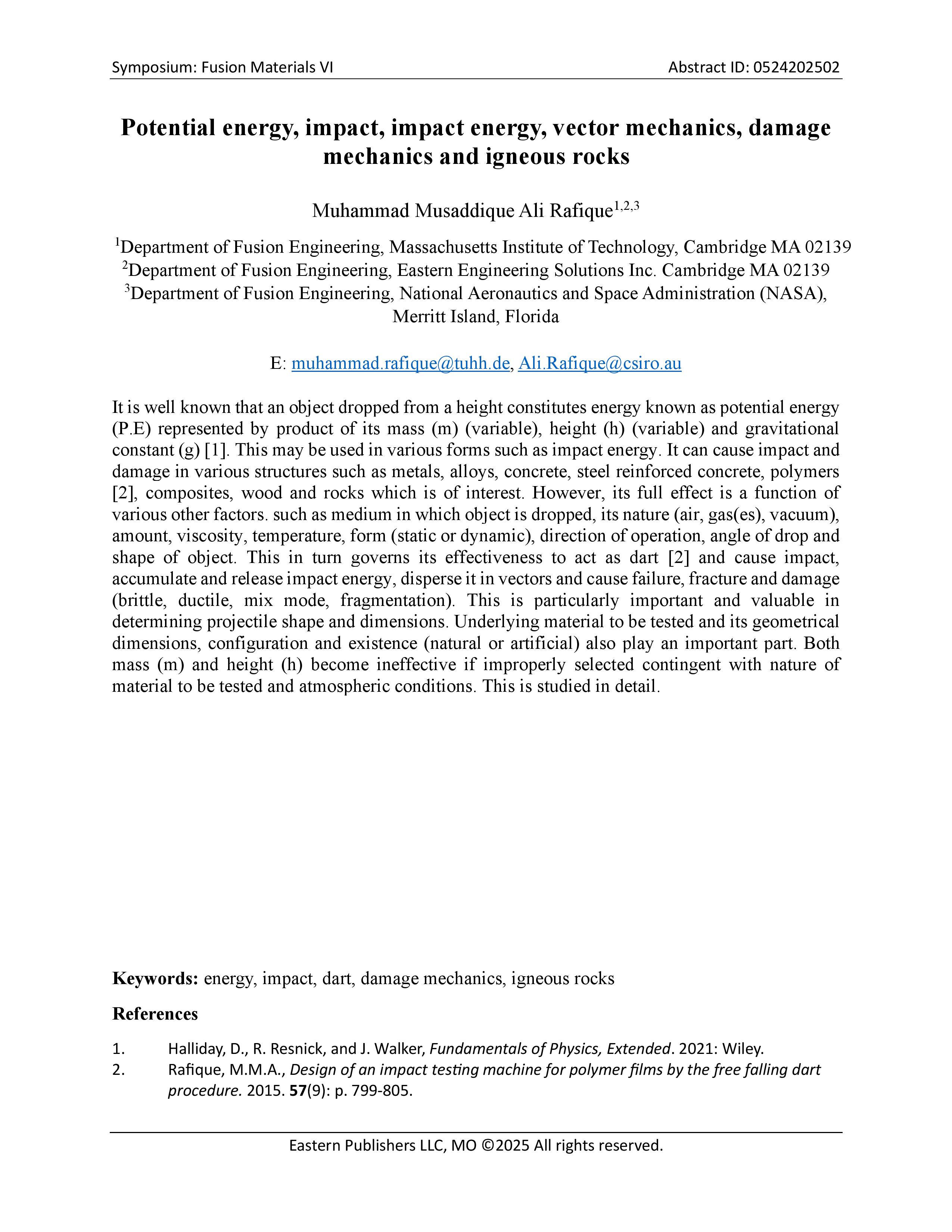
It is well known that an object dropped from a height constitutes energy known as potential energy (P.E) represented by product of its mass (m) (variable), height (h) (variable) and gravitational constant (g). This may be used in various forms such as impact energy. It can cause impact and damage in various structures such as metals, alloys, concrete, steel reinforced concrete, polymers, composites, wood and rocks which is of interest. However, its full effect is a function of various other factors. such as medium in which object is dropped, its nature (air, gas(es), vacuum), amount, viscosity, temperature, form (static or dynamic), direction of operation, angle of drop and shape of object. This in turn governs its effectiveness to act as dart and cause impact, accumulate and release impact energy, disperse it in vectors and cause failure, fracture and damage (brittle, ductile, mix mode, fragmentation). This is particularly important and valuable in determining projectile shape and dimensions. Underlying material to be tested and its geometrical dimensions, configuration and existance (natural or artificial) also plays an important part. Both mass (m) and height (h) becomes ineffective if improperly selected contingent with nature of material to be tested and atmospheric conditions. This is studied in detail.
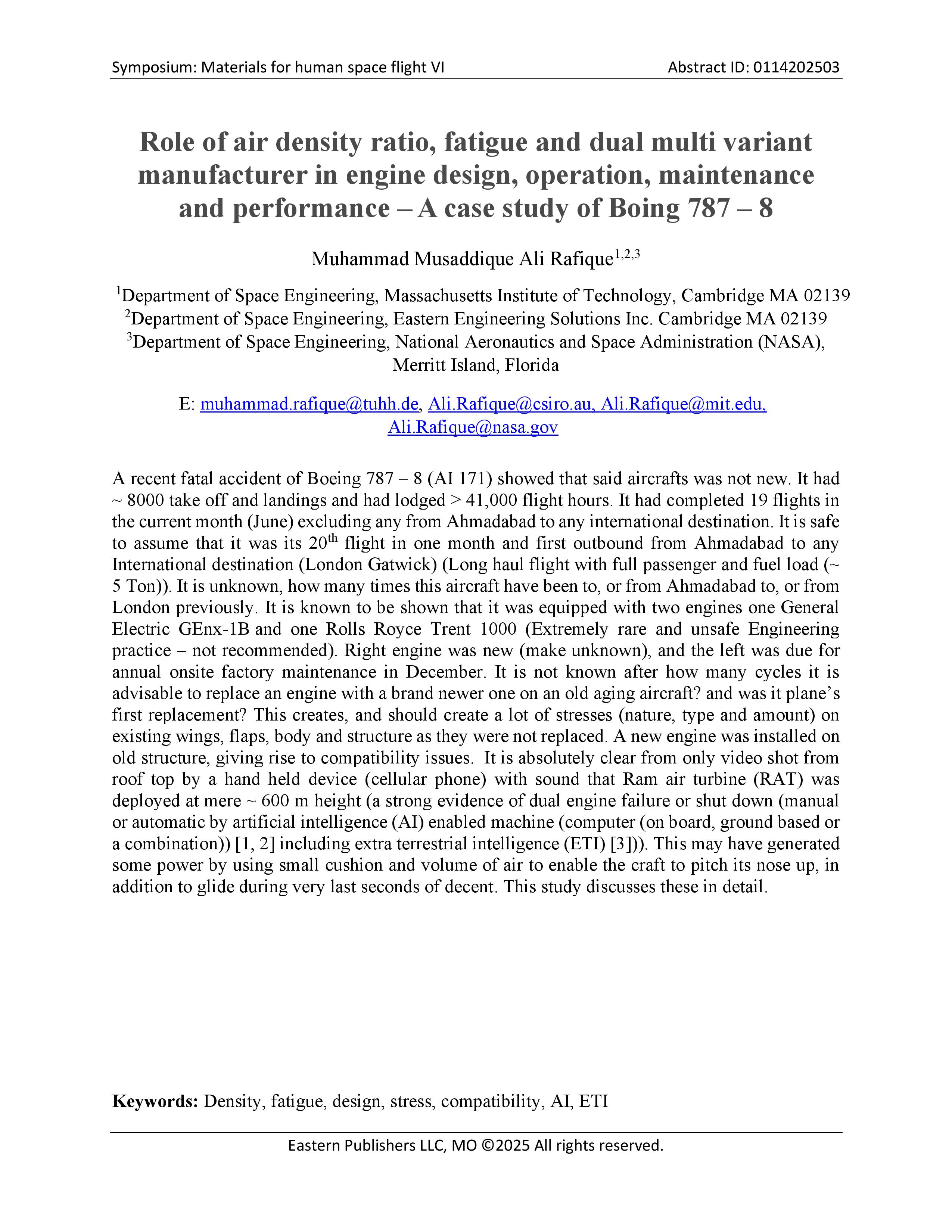
As recent fatal accident of air india 171 unfolding, it is becoming more clearer that said aircrafts was not new. It had ~ 8000 take off and landings and had lodged > 41,000 flight hours. It had completed 19 flights in current month (June) excluding any from Ahmadabad to any international destination. It is safe to assume that it was its 20th flight in one month and first outbound from Ahmadabad to any International destination (London Gatwick) (Long haul flight with full passenger and fuel load (~ 5 Ton)). It is also unknown that how many times this aircraft have been to, or from Ahmadbad to, or from London previously. It is also known that it was equipped with two engines one General Electric GEnx-1B and one Rolls Royce Trent 1000 (Extremely rare and unsafe Engineering practice – not recomended). Right Engine was new (make unknown), and left was due for annual on site factory maintenance in December. It is not known after how many cycles, it is advisable to replace an engine with a brand newer one on an old aging aircraft? and was it plane’s first replacement? This creates, and should create a lot of stresses (nature, type and amount) on existing wings, flaps, body and structure as they were not replaced. A new engine was installed on old structure giving rise to compatability issues. It is absolutely clear from only video shot from roof top by a hand held cellular phone with sound that Ram air turbine (RAT) was deployed at mere ~ 600 m height (a strong evidence of dual engine failure or shut down (manual or automatic by artificial intelligence (AI) enabled computer)). This may have generated some power by using small cushion and volume of air to enable the craft to pitch its nose up, in addition to glide during very last seconds of decent. This study discusses these in detail.


 Muhammad Musaddique Ali Rafique
You must be logged in to post a comment.